

The more you scroll, the more you find!
Stille Nacht, Holy Night

Stille Nacht, Holy Night
The long night was coming to its conclusion in the small, isolated town of Mariapfarr, Austria. There would not however be a day break nor a glimpse at the magnificent rising sun. A bright and glorious morning that normally is the salvation to the weary soul would fail to bring relief. The consistent, radiant light that has proudly shined since the third day of Creation would not thrust its beams upon the fields, streams, trees, nor city streets of Europe for yet another dark and dreary day. In the year prior, April of 1815, a volcano had erupted in Indonesia that had lasting effects. The end result of nature’s groaning was that of crop failures, famine, and death, and it was felt across the globe. The little town of Mariapfarr was certainly not exempt from the pain. Joseph Mohr awoke out of his slumber ready to surrender his own will to the Lord and take upon himself, with all his might, the duty of assistant pastoral leadership that had been bestowed to him. After saying his prayers he lit a candle and prepared to travel to the old gothic church of Mariapfarr where he served. As Joseph set the candle down on the nightstand he coughed; this was a sign of the travail he would continue to endure along the many journeys from his residence to the church. With a lantern in hand he closed the apartment door, and began his winter trek upon the snow covered road to the church. As he walked, snowflakes fell from the sky and the chilling breeze continued to fill his lungs intensifying the tuberculosis already effecting his body. At the time the illness was of little importance to Joseph, for there was an entire community of people in need of help, guidance, and hope. Not just the Mariapfarr community, the world at large was in darkness and 1816 would become known as “the year without summer”. For the people of Austria, the year of 1816 was not the beginning of their tribulation, rather the continuation of ongoing struggle and hardship. For over a decade the people of Austria had been devastated by continual war with the French army lead by Napoleon Bonaparte. The darkness of winter perfectly Incapsulated the physical and spiritual status of the nation; they were cold, poor, beaten down, and defeated.
Joseph Mohr had what a desperate community, nation, and world needed; not silver or gold, for he was poor like they were. He carried with him “good tidings of great joy” in his heart, and in the Lord’s timing the power of the Christmas story, which is to say the Gospel story, would continue to change the world like it has since that blessed night underneath the stars of Bethlehem. Joseph Mohr arrived to the church that morning, and there at the altar was a painting hung on the wall that was of the Virgin Mary and Baby Jesus. He greatly admired the painting, so much so that he began creating a poem, and in that year it came to completion. The poem was titled Stille Nacht, Heilige Nacht. Translated to English it is Silent Night, Holy Night:
Silent Night! Holy Night!
All are sleeping, alone and awake Only the intimate holy pair, Lovely boy with curly hair,
Sleep in heavenly peace!
Sleep in heavenly peace!
Silent night! Holy night!
Son of God, O how he laughs
Love from your divine mouth,
Then it hits us-the hour of salvation . Jesus at your birth!
Jesus at your birth!
Silent night! Holy Night!
Which brought salvation to the world,
From Heaven’s golden heights,
Mercy’s abundance was made visible to us: Jesus in human form,
Jesus in human form.
Silent night! Holy night! Where on this day all power
of fatherly love poured forth
And like a brother lovingly embraced Jesus the peoples of the world, Jesus the peoples of the world.
Already long ago planned for us,
When the Lord frees from wrath
Since the beginning of ancient times
A salvation promised for the whole world. A salvation promised for the whole world.
Silent night! Holy night!
To shepherds it was first made known By the angel, Alleluia;
Sounding forth loudly far and near: Jesus the Savior is here!
Jesus the Savior is here!
The poem would not be performed in 1816, and it may have never been brought forth into public knowledge if it had not been for a damaged church organ! Joseph’s health continued to dwindle getting worse and worse; in 1817 he moved away from the mountainous climate of Mariapfarr to another impoverished town called Oberndorf which is located outside of Salzburg. Joseph served at St. Nicholas Church as an assistant priest. It was at St. Nicholas Church where he kindled a friendship with the church organist whose name was Franz Gruber. The next year on Christmas Eve, preparations were being made for the Christmas Eve Mass, when a terrible discovery was made at St. Nicholas Church; the organ used to play the Christmas Hymns and needed to accompany the choir would not be available for the Christmas Eve service. The church organ was not working and was in need of repair. Joseph Mohr, worried that the Christmas service was under threat of not having music, went to his friend and asked him for assistance. Joseph revealed the poem he had written two years prior, and he asked Franz Gruber to create a melody and chord progression to accompany his poem with only a few hours until the service began. Franz excepted the challenge, and with time to spare, the song was ready to be performed for the first time, Silent Night, Holy Night.
St. Nicholas Church was full on Christmas Eve night in 1818. After Mass, All were silent waiting for what was to come. To their surprise those in attendance did not hear the church organ play nor orchestral strings in harmony; instead they looked on with curiosity as Jospeh Mohr stood on stage with a simple guitar, an instrument not traditionally used to glorify God within a church sanctuary. The guitar was played in gatherings outside of church walls, for it was thought of in low esteem, it was the “poor man’s piano”. A fitting instrument to describe the meek and humble Savior who, sitting on the right hand of the Father, descended to a lowly manger in Bethlehem. 2 Corinthians 8:9 says “For ye know the grace of our Lord Jesus Christ, that, though he was rich, yet for your sakes he became poor, that ye through his poverty might be
rich.” Joseph was on stage with his friend Franz, and together they sang Silent Night in harmony for the world to hear! After Christmas Eve of 1818, Silent Night spread throughout Austria, Germany, and rapidly throughout the world, while the names of Joesph Mohr and Franz Gruber fell into obscurity (until October of 1995 when it was confirmed with a manuscript that Joseph Mohr wrote Stille Nacht, Heilige Nacht in 1816). Both men lived for a higher purpose, to love God and love their neighbor. Joseph Mohr was known for his generosity, giving away most of his funds to those in need. He died on December 4th, 1848 as a poor man after succumbing to respiratory illness once and for all. “Poor” of course is relative, and the famous line said by Harry Bailey to his brother George at the end of “It’s A Wonderful Life” applies to Joesph Mohr, “A toast to my big brother George, the richest man in town.” Joseph Mohr lived the words of John the Baptist in John 3:30, “He must increase, but I must decrease.” Although baptized in the same waters as Wolfgang Amadeus Mozart, Joseph Mohr is not celebrated to the magnitude of his fellow countryman. Joseph Mohr playing his guitar pales in comparison to Mozart on a fortepiano; but the power that has sprung forth from Joseph’s simple poem has proven to stop army’s dead in their tracks; it has been the conduit for real peace on earth amidst the fires of war and the raging of human hearts. Silent Night incapsulates the power of the Virgin Birth, the power of the Crucifixion, and the power of the Resurrection. It is okay to forget Joseph Mohr, Franz Gruber, and even Silent Night; but always acknowledge in everything the one who they sung about and lived for, the Savior, the Risen King, the Lord Jesus Christ!
*A note after editing: The story of Silent Night is a beautiful “Christmas story”, I pray that if you have never read or scene a documentary explaining how Joseph Mohr and Franz Gruber ended up singing the wonderful song on Christmas Eve night you will have gained enough interest from my blog post to learn more about the event. Back in 2020 I became very fascinated with the French Revolution and more specifically the Napoleonic Wars that followed thereafter. From the late 1790’s, Europe fell into war like the continent had never seen and it lasted until the defeat of Napoleon in 1815 At the Battle of Waterloo. While researching the offensive campaigns of France, the counter attacks of Russia, or Spain’s brutal gorilla style warfare that kept the “Grande Armée at
bay, it does not take much imagination to understand how the people of Europe were devastated from war and death, they were in need of peace. In December of 2020 I stumbled upon a PBS documentary titled
The First Silent Night. The documentary was a primary source for my post as it outlines the events leading up to Christmas Eve of 1818 when Silent Night was sung for the first time. Watching it when I did, after learning so much about the war that had preceded it, helped me understand even if but a little why the words of hope of everlasting peace brought forth by Jesus meant so much to the world at that time. This past week while researching and preparing my post I went to the cumming library and read a wonderful little children’s book titled Silent Night: The Song And It’s Story By Margaret Hodges. There as I sat reading I began to weep tears of joy and looking a little crazy to those around me; feeling what can only be described as (to use a German word) Sehnsucht, a longing and desire to embrace the Lord with open arms and thank Him for His relationship with me. I have living inside of my heart the One who brings peace to a world trying to destroy itself; Jesus ends The battles of my mind, He calms the raging storms of my heart, and He floods my soul with Heavenly peace that will last for eternity. Please I implore you, look deeper into the wonderful story of Silent Night.
Written by Jacob Littlefield
Things Worth Admiring

Hello, hello!!
I am not terribly experienced conveying my thoughts with the written word and its various formats. Those of you who are familiar with me know I love words, their definitions, etymologies, and the various ways we employ language, but the overwhelming majority of my expressions are verbal. I do dabble in poetry a bit so I would expect to quote some famous passages on occasion. I state all this, in part, to request some leniency on your end. I have little to no experience editing, polishing, or rendering a blog entry into its most readable format. There will be plenty of grammatical errors, several misspellings, and poor editorial choices. I beg for your forgiveness well in advance, and when I am in town with you all in person your corrections and critiques would be most welcomed. One last thing—I am fairly long winded, so I expect these to be a bit longer than the wonderful posts we have been able to enjoy thus far. If lengthy, meandering, tedious expositions are not your thing then please skip these submissions.
With that out of the way I would like to introduce the plan for this space. My intention is to produce four pieces after this foundational introductory one. The overarching
theme is “Things Worth Admiring”. Throughout these blog entries I will bring up people, characters, and things that I believe illustrate aspects of Christ worth emulating. Probably, many of you have already incorporated several of these things into your life; in those situations I would desire this format to aid in emphasizing those attributes that have enlivened your existence. Additionally, I am not saying that these individuals are necessarily worth admiring. Quite the contrary, I personally am a big advocate of we should not admire people. This is not doctrine, nor a suggestion that you should adopt this philosophy. Obviously there are people we could, maybe even should, admire. But practically speaking I find it best for me when I see one of those individuals to ascertain what specific thing/things they do that glorify or replicate Jesus. If there is an individual that has many aspects of God about them then technically there is nothing wrong whatsoever with admiration of them especially if we understand that it is Christ who we ultimately admire. Nevertheless, my preference is the stark distinction of only admiring Jesus. It also makes life slightly smoother when our heroes inevitably fall or fail.
Now on to some of the tedious matters foreshadowed earlier. Definitions and context are indispensable aids for clarity and understanding. I will most often be citing the American Heritage Dictionary (AHD) for a modern definition. The Oxford English Dictionary (OED) is phenomenal but is significantly paywalled, and Merriam-Webster’s dictionary is also more than adequate. Webster’s 1828 dictionary is very useful for the historical context of English definitions. When the words we dive into are in the Bible, I will occasionally be employing Strong’s Concordance for its systematic numbering and cross-referencing abilities to see how else the word was translated. Having the different contexts for how the Bible uses words should help frame how we understand them. For etymologies we will use various online sources and tools. I am not the greatest at citations so if there are any specific questions about a source or where a definition comes from please reach out. So let us delve unnecessarily further into explaining what we probably already know.
“Things Worth Admiring”. The first word is “Things”. We will not go in depth with this one. Things are
attributes, qualities, morals, emotions, aspects, philosophies (from a layman’s perspective), virtues, abilities, and a number of similar concepts. The big distinction here is that, ideally, these will all be ultimately specific to Jesus Christ my Lord and Savior who is coequal with God and the Holy Ghost, the Spirit of Truth who He sent to be our Comforter. [Matthew 16:16-17, John 10:30, Titus 2:13, John 14:16-17, Colossians 2:6-15]
“Worth”. The AHD defines worth as, “ noun. 1. The quality that renders something desirable, useful, or valuable: 4. Wealth; riches: 5. Quality that commands esteem or respect; merit: Adjective. 2. Deserving of; meriting:”. The 1828 dictionary also identifies “Importance” as a defining characteristic of “Worth”. Interestingly, worship comes from a Middle English compound of worth and ship (ship meaning the condition of being or the quality of; not the buoyant vessel for maritime use). So very literally what we find worth in we definitionally worship. This lends itself to the concept of finding worth in people is akin to worshipping people. As Christians we understand Christ is the only One worthy of worship and anything worthwhile in us or other creatures
is exclusively of God. [Exodus 34:14, Matthew 19:17, Revelation 4:11, Romans chapters 7 and 8.] Though we would be hard pressed to find another Christian who would state otherwise it does not seem remotely as difficult to find one who behaves contrary. Most of the time we just have to find a mirror. Be cognitive and specific what you deem of worth.
“Admire”. You are encouraged to look up technical definitions and etymologies from your preferred sources on your own. There is a treasure trove of fun and useful information, as there are with so many words, but in this small space I would like to focus on how the Bible uses this term. My understanding is that this English word and its variations are only used in three verses in Scripture. If you find more please expand my understanding by informing me. There is one in Jude 1:16 “These are murmurers, complainers, walking after their own lusts; and their mouth speaketh great swelling words, having men’s persons in admiration2296 because of advantage.” [The numbers following the word are Strong’s numbers and they are tied the the original language word used in Scripture; translators then apply an English word that effectively conveys the original meanings.] Revelation
17:6 has another, “And I saw the woman drunken with the blood of the saints, and with the blood of the martyrs of Jesus: and when I saw her, I wondered with great admiration2295. The final one comes from 2 Thessalonians 1:10, “When He shall come to be glorified in His saints, and to be admired2296 in all them that believe (because our testimony among you was believed) in that day”. So we have three instances and Strong’s numbers indicate two original language words. This is simple right? Well, welcome to Biblical word studies. No. Just as Robert Frost knew, “how way leads on to way” we know words lead on to words.
A common interpretation of successive numbering from Strong’s Concordance is that the words are closely related or variations of the same word. This is not always the case so verify before proclaiming, but it is often the case. The Greek word for 2295 is: θαύμα, the transliteration is: qauma, Strong’s phonetic representation is: thou'-mah; For 2296 it is: θαυμάζω, the transliteration is: qaumazō, the phonetic representation is: thou-mad'-zo. For any D&D nerds out there the root word here is the same for Thaumaturgy. I would phonetically represent 2295 as: thau'-ma. Definitionally 2295 is wonder, admiration;
while 2296 is to wonder, to admire, to be in admiration, marvel. 2295 is used once in the New Testament. We have already illustrated it. 2296 is where Frost’s philosophy starts to bear fruit. It is used 46 times. Another disclaimer. The numbers used here come from the Blue Letter Bible online resource and we are mapping the words onto the KJV. Different sources have different numbers so if you delve into this yourself you will see some variations on the exact numbers. Out of those 46 uses “marvel” is the English word employed the most. “Wonder” comes in a respectable second place. The first time we come across this word in the New Testament is when Jesus marvels at the centurion’s faith In Matthew chapter 8.
So that is how I am looking at “things worth admiring”. A decent example of the people and attributes we could be going over can be found in the centurion of Matthew 8 and Luke 7. His faith is something worth admiring. Obviously, because if Jesus finds it so it is a safe bet we should also. We would break down that example, tease out the word faith technically, possibly look for practical personal applications, and always map it onto Christ. But this will not be limited exclusively to characters in the
Bible. Historical individuals will probably be presented, and the attributes are not necessarily always going to be traditional Biblical virtues. “Beauty” is something worth admiring and I suspect that I will delve into that in one of these posts next year.
Be incredibly circumspect about who and what you admire. Satan is very well versed in subtlety and temptation. With that combination it takes very little forethought to understand how devastating it can be to admire improper things or to conflate a proper thing with an improper person. Quick spoiler alert, we are all improper. Jesus is the ultimate example and the idea for these posts is only meant to illustrate that in a manner which might be slightly unique to me.
One final disclaimer, and then the conclusion. AI was not used at all for this piece. I will probably use it some for research in the future. I for sure need to use it for grammar. But, Lord willing, I will never use to think, nor to write something for another’s consumption. It reminds me of when I was in school and the internet was going from prevalent to pervasive. Some students thought it was the greatest thing. “I have this report due about
whatever subject or book. Why don’t I just copy and paste an article or report from someone who actually understands the subject then change some of the words to my own?” To me this was always foolishness. I was not alone. Society, as best as I could tell with my limited perspective, also seemed to denounce such practices. Even most people doing it often did it surreptitiously because, if nothing else, they intuitively knew it was improper. A small concern for me today is that society seems bifurcated on whether or not AI writing your emails, texts, reports, essays, and even your personal notes is a good thing. AI like the internet is probably a great thing, but with enhanced capacity comes greater potential for abuse. Like most people I use the internet constantly and I imagine I will eventually use AI (or at least its functions) immensely in the future. I potentially used the internet properly in most contexts, and my hope is that I may do the same with AI. I feel this needs to be stated because a significant objective with this post is to let any potential audience understand a little about me. I also think it is relevant to who and what we admire. Stunting your God-given intellectual capacity and ability is not an admirable quality.
So what is the point of this tedious overly complex piece? It is to state from a technical, definitional perspective the same simple concepts we convey to children in Sunday School when we teach them about Jesus walking on the water and more specifically when Peter sinks into the water. When Peter sees the wind boisterous and loses focus on Christ he stops seeing Christ, he stops perceiving Him, he stops worshipping the Savior, he stops admiring the Messiah, and he directs his attention and admiration (and all that entails) to the boisterous wind. Doubt is something we all encounter throughout our entire lives. Many people see doubt as this bad thing that should be hidden at all costs. And while doubt does miss the mark it is highly informative. Doubt is a very reliable indicator that our eyes have been taken off of Jesus. So next time doubt starts to manifest within your heart focus upon Life. Yes, the mortgage is due, the kids have a health issue, your livelihood is at stake, the car broke down... again, people see you as insignificant, your plans are falling apart, this temporal world seems all encompassing, and even death is at the door. But, focus on Life. Focus on Life. Just focus on Life.
He is worth admiring.
A Surrendered Servant's Heart

A Surrendered Servant’s Heart...
“I have shewed you all things, how that so labouring ye ought to support the weak, and to remember the words of the Lord Jesus, how he said, It is more blessed to give than to receive.” Acts 20:35
Dear Beloved Members of the Body,
As we rise each morning and prepare for the day before us, drinking our first cup of coffee or tea, we often pray and ask the Lord to bless our needs, our struggles, our anxious thoughts, and our desire for help in an area of weakness. We tend to think of what we lack, or what we desire Him to fix, or the burdens we ask Him to remove. These prayers are precious to the Lord, yet I ask you today: What is truly on our hearts each day? Are we longing for His will, or are we more concerned with our own? Do our longings align with God’s heart, or do they keep us from seeing the greater calling before us? Scripture warns us:
The heart is deceitful above all things, and desperately wicked: who can know it? I the LORD, search the heart, I try the reins, even to give every man according to his ways, and according to the fruit of his doings. Jeremiah 17:9-10
Our hearts tend to keep us focused only on what benefits us... We might rush to work, sit at the kitchen table, log in from home, or take our place in a busy environment, but may I ask the question, what consumes our thoughts? Are we counting down the hours until the day is over, or are we thankful God has given us another opportunity to glorify Him and His love towards others? Our hearts can easily drift toward selfishness, fear, distraction, and pride. We can become so preoccupied with our goals, our comfort, and our plans that we forget Christ has called us to something far greater, a surrendered servant’s heart. We live in a world filled with constant noise: phones buzzing, entertainment longing for our attention, workplaces demanding our devotion, and a culture among men that promotes self-importance. We may find ourselves engaging in idle conversations, gossiping, coveting, complaining instead of giving thanks, comparing rather than celebrating others, staying busy instead of drawing closer to God, seeking comfort instead of serving, and ultimately blending in and becoming self-righteous instead of standing out.
For we hear that there are some which walk among you disorderly, working not at all, but are busybodies. 2 Thessalonians 3:11
We are living in a fallen and broken world, one that constantly pulls at our hearts and minds. It is easy to get swept into today’s self-centered culture, where we become overly focused on other
people’s lives, frustrations, and drama. From the moment we clock in at work to the conversations happening around us, wickedness and worldly behavior surround us. If we’re honest, it can be tempting to join in and think, “Everyone else is doing it… Why shouldn’t I?” But brethren, that is exactly why we must be different. That is why we must be intentional. The very darkness around us should remind us of our purpose to shine for Christ and to serve Him by serving others. We are not called to blend in, but to stand out for the glory of God. And the Word of God commands us:
2 And be not conformed to this world: but be ye transformed by the renewing of your mind, that ye may prove what is that good, and acceptable, and perfect, will of God. Romans 12:2
We are not called to reflect the brokenness of this world; we are called to reflect Christ within it. We are no longer who we once were. Jesus has rescued us from the bondage of sin and invited us into everlasting life. By His precious blood, our souls have been redeemed. Through baptism, we were buried with Him, and through His resurrection, we were raised to walk in newness of life. We have been set apart, not to blend in with the world, but to be transformed by Christ Jesus our Lord. We are the light shining in darkness. We are the salt that preserves the truth. We are a city set upon a hill meant to be seen and designed to point others to Jesus.
This means our hearts must be surrendered not to culture, but to the King of Kings, and the Lord of Lords. Yet, I wonder how many of us let this truth escape our hearts?
4 Ye adulterers and adulteresses, know ye not that the friendship of the world is enmity with God? whosoever therefore will be a friend of the world is the enemy of God. James 4:4
How often do we pause and truly see the people God places in our path each day? The coworker hiding pain behind a forced smile… the stranger weighed down by life… the family member longing to feel valued. Do we slow down long enough to care about their needs above our own? A surrendered servant’s heart chooses to love even when it costs us something. It says, “Lord, not my comfort… but Your compassion. Not my pride… but Your purpose.” When we lay aside our preferences, our desire to be noticed, and our need to be first, Christ becomes visible through us. In those small, quiet moments of humility, others can encounter the Savior living within us. To be a servant of Christ is to willingly dedicate our entire lives to Him, our words, our actions, our attitudes, even the thoughts no one sees. It is to say, “Jesus, let every person I meet today see you and not me. May I decrease, so you can increase! Lord, may you use me today for Your Will and not that of my own. May I be obedient to you, and seek your Spirit, and deny my flesh.” It is our greatest privilege on this earth to introduce someone to Jesus… simply by meeting us.
For, brethren, ye have been called unto liberty; only use not liberty for an occasion to the flesh, but by love serve one another. Galatians 5:13
What I love the most about the Lord is that he can strengthen us to do His will if we deny our flesh and pursue the Spirit. Humility may not feel glamorous, obedience can feel difficult, yet God strengthens the surrendered heart to do what seems impossible. Moreover, nothing done for the sake of Christ is ever wasted.
Therefore, my beloved brethren, be ye stedfast, unmoveable, always abounding in the work of the Lord, for as much as ye know that your labour is not in vain in the Lord. 1 Corinthians 15:58
God has always chosen humble hearts to carry out His greatest purposes. When I look at Scripture, I see ordinary people, just like us, who simply said yes to God.
Abraham didn’t understand why God asked him to lay Isaac on the altar… but he trusted God more than his own understanding, and God provided a miracle. Moses walked away from privilege and comfort to stand with God’s people in their suffering because obedience mattered more than status. David stumbled and fell at times, yet he kept returning to the Lord with a heart fully surrendered, and God called him a man after His own heart. What made these people so usable in the hands of God was not perfection… but surrender. And above them all stands our Lord and Savior, Jesus Christ, the One who could have demanded to be served, yet chose instead to kneel, to wash feet, to love the outcast, and to offer His life upon the cross. God himself chose to lower himself in the likeness of man and became the greatest example of what it means to be a Servant.
Every time someone chose to surrender… God’s glory was revealed.
5 Let this mind be in you, which was also in Christ Jesus: Who, being in the form of God, thought it not robbery to be equal with God: But made himself of no reputation, and took upon him the form of a servant, and was made in the likeness of men: And being found in fashion as a man, he humbled himself, and became obedient unto death, even the death of the cross. Philippians 2:5-8
I write to you today only because of the servant hearts of two believers, Rebecca and Andrew. When I was lost, broken, and not living in Christ Jesus, the Lord placed them uniquely in my life through a chiropractic office. When I doubted God’s love and could not see hope... when my heart was far from him. They did not turn away from me. They shared the endless, unwavering love of God with me. They listened to my struggles. They walked beside me as they watched me continue down the road of utter darkness, even worshiping pagan idols; they did not turn away from me. They reminded me that Jesus loved me and wouldn’t give up on me, so neither would they. They listened to my rejection of Christ for over two years and did not turn away from me. My beloved church body, it is because of their loving obedience to Christ that I came to Greater Heights Church, and it is because of God’s grace through their obedience that I am saved today. That is the power of a surrendered servant’s heart.
And whatsoever ye do, do it heartily, as to the Lord, and not unto men; Knowing that of the Lord ye shall receive the reward of the inheritance: for ye serve the Lord Christ. Colossians 3:23-24
Every person we encounter- coworkers, family, strangers, even the difficult ones- is a soul Jesus died for. And every interaction is a chance to serve the Lord. This day and every day, we all will have opportunities to speak hope to someone discouraged, show kindness to someone who feels unseen, tell someone about Jesus’s love for them, pray for someone too weak to pray for themselves, give without expecting return, and share Jesus’s tender-hearted mercy towards them.
Every act of service is and becomes a testimony of Christ.
To the beloved members of the Body, let us rise with a new heart each morning that is surrendered to being a servant of Christ. Lord, empty ourselves of who we are, fill us with Your Spirit, and Lord, lead us to someone who needs Your Love and kindness, and may they meet You, Jesus, when they meet me.
12 I beseech you therefore, brethren, by the mercies of God, that ye present your bodies a living sacrifice, holy, acceptable unto God, which is your reasonable service. Romans 12:1
May we surrender our hands, our time, our attitudes, our conversations, our plans, our everything – to the glory of Christ Jesus our Lord.
For His name, For His glory, For His Kingdom, For His unwavering love. May the world know Christ because they have known us.
With all love in Christ Jesus, Your beloved sister
Gethsemane
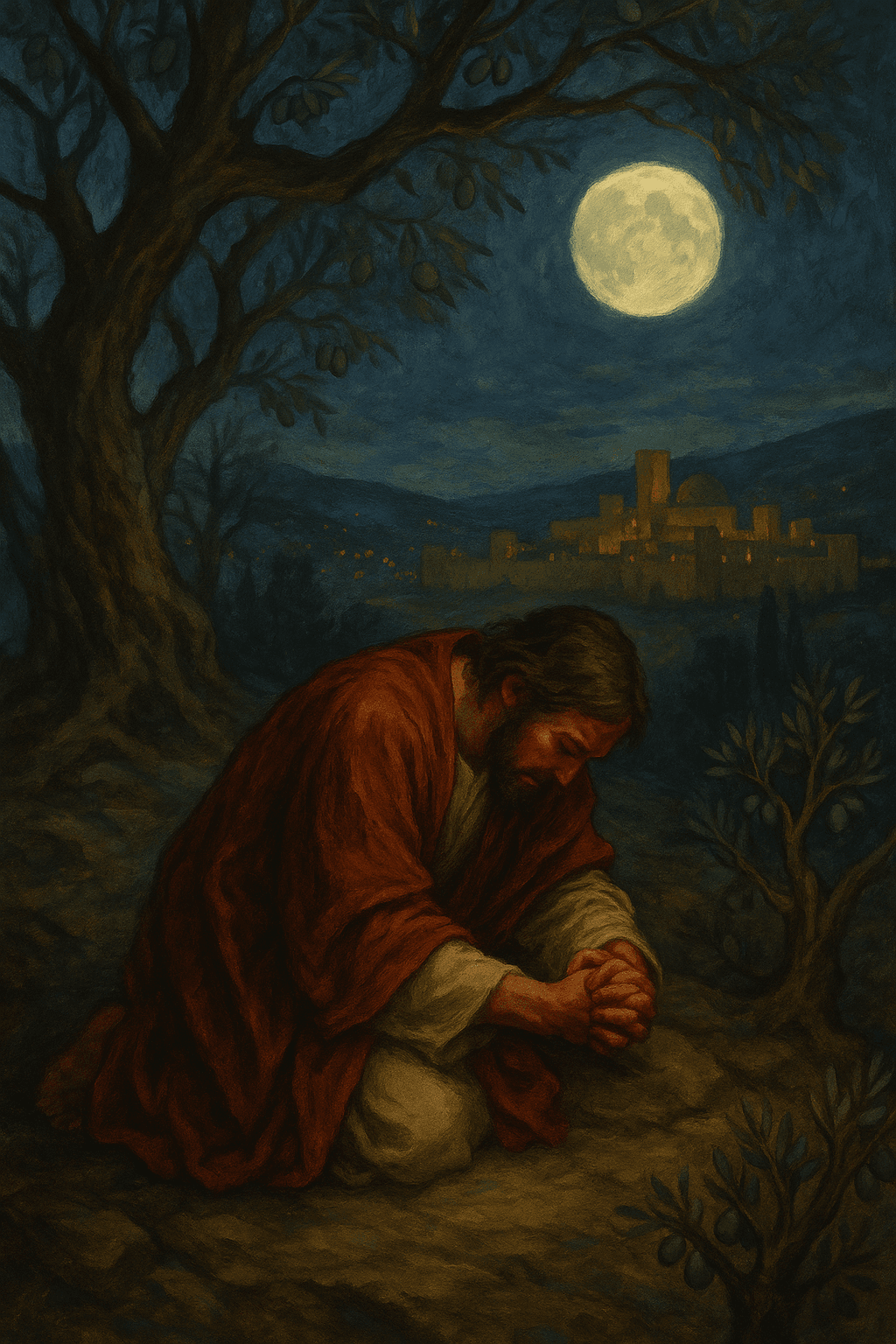
Gethsemane
“Then Jesus went with them to a place called Gethsemane, and he said to his disciples, ‘Sit here, while I go over there and pray.’ And taking with him Peter and the two sons of Zebedee, he began to be sorrowful and troubled. Then he said to them, ‘My soul is very sorrowful, even to death; remain here, and watch with me.’ And going a little farther he fell on his face and prayed, saying, ‘My Father, if it be possible, let this cup pass from me; nevertheless, not as I will, but as you will’”(Matthew 26:36-39).
Moments before he would be betrayed by one He’d poured love and wisdom into, hours before he would be crucified on a cross along with common thieves, Jesus journeyed up the slope of the Mount of Olives to a small grove of olive trees, the Garden of Gethsemane. Here He would speak the words, “My Father, if it be possible, let this cup pass from me; nevertheless, not as I will, but as you will.” Overlooking the city of Jerusalem, surrounded by olive trees, Jesus was in agony.
In today’s world, 90% of olives that are harvested are processed into their most valuable resource - olive oil. Used for food, medicinal purposes, health and beauty treatments, and household cleaning, olive oil remains a versatile and beneficial commodity today, much like it was in Jesus’ time. Though it would have been regarded with even higher value then, as it was unique - not one of many like the various canola, sunflower, coconut, and other varieties of oil available today. To them, it was precious. It was a part of everyday life, not only in food and hygiene and medicine, but also in tasks as essential and sacred as lighting and anointing.
In the Old and New Testament, we see examples of oil being used as fuel for lamps. In Exodus 27, as God relays His instructions for the construction of the tabernacle to Moses, he says, “You shall command the people of Israel that they bring to you pure beaten olive oil for the light, that a lamp may regularly be set up to burn.” And when God is giving instruction to the Levites for the laws of priests and Tabernacle worship, He tells Moses in Leviticus 24, “Command the people of Israel to bring you pure oil from beaten olives for the lamp, that a light may be kept burning regularly.” It was foundational to the Tabernacle that pure olive oil be used to keep a light shining continually. And later in the New Testament, Jesus gives a parable in Matthew 25 of ten virgins who keep oil in their lamps as a symbol of readiness and anticipation for the return of the bridegroom, our Savior.
Oil also had the sacred purpose of being used for anointing. When the Tabernacle was built, olive oil not only had a part in being used for the burning of the lamps, but also in their consecration. In Exodus 30: 23-32, God gives his instruction to anoint the furnishings of the Tabernacle and those who would carry out its purpose. He says, “Take the finest spices: of liquid myrrh 500 shekels, and of sweet-smelling cinnamon half as much, that is, 250, and 250 of aromatic cane, and 500 of cassia, according to the shekel of the sanctuary, and a hin of olive oil. And you shall make of these a sacred anointing oil blended as by the perfumer; it shall be a holy anointing oil. With it you shall anoint the tent of meeting and the ark of the testimony, and the table and all its utensils, and the lampstand and its utensils, and the altar of incense, and the altar of burnt offering with all its utensils and the basin and its stand. You shall consecrate them, that they may be most holy. Whatever touches them will become holy. You shall anoint Aaron and his sons, and consecrate them, that they may serve me as priests. And you shall say to the people of Israel, ‘This shall be my holy anointing oil throughout your generations. It shall not be poured on the body of an ordinary person, and you shall make no other like it in composition. It is holy, and it shall be holy to you.’” Later on, when God called Samuel to appoint Israel’s first king, we see how oil was used in Saul’s anointing in 1 Samuel 10:1, “Then Samuel took a flask of oil and poured it on his head and kissed him and said, ‘Has not the Lord anointed you to be prince over his people Israel? And you shall reign over the people of the Lord and you will save them from the hand of their surrounding enemies. And this shall be the sign to you that the Lord has anointed you to be prince over his heritage.’”
We see the examples of oil being used for God’s holy purposes laced through Scripture, and with that, we’re given examples of oil being use as a symbol for the Holy Spirit. We see this clearly in 1 Samuel 16:13 when Samuel anoints Israel’s new kind, David, “Then Samuel took the horn of oil and anointed him in the midst of his brothers. And the Spirit of the Lord rushed upon David from that day forward.” Isaiah 61:1 draws comparison between the anointing with oil and the Spirit of God, “The Spirit of the Lord God is upon me, because the Lord has anointed me to bring good news to the poor; he has sent me to bind up the brokenhearted, to proclaim liberty to the captives, and the opening of the prison to those who are bound;” In the New Testament, in 2 Corinthians 1:21-22, we see where the anointing with oil in the Old Testament becomes the Holy Spirit coming to dwell in believers. “And it is God who establishes us with you in Christ, and has anointed us, and who has also put his seal on us and given us his Spirit in our hearts as a guarantee.” Throughout Scripture, oil is connected with light and holiness, and it is directly tied to the presence of the Spirit.
When Jesus knelt in the Garden of Gethsemane, he knelt in agony. Luke 22:44 says, “And being in agony he prayed more earnestly; and his sweat became like great drops of blood falling down to the ground.” Our Savior, soon to be betrayed and knowing it, was sorrowful, praying to God the Father and asking for another way. And yet, God’s will be done.
The word “Gethsemane” means “olive press.” In Jesus’ day, oil was extracted from olives in a fairly simple yet strenuous process. The olives were first crushed, to break the flesh and release the oil from the cells, and then pressed, to extract all of the liquid. When Jesus knelt in the garden, he was beginning to experience the crushing and pressing of the weight of the sins of mankind. Isaiah prophesied about the Savior, “But he was pierced for our transgressions; he was crushed for our iniquities; upon him was the chastisement that brought us peace, and with his wounds we are healed.” And so the crushing begins in the garden - in the olive press.
Jesus had told his disciples, “Nevertheless, I tell you the truth: it is to your advantage that I go away, for if I do not go away, the Helper will not come to you. But if I go, I will send him to you” (John 16:7). He must go in order to send us the Spirit - a valuable resource for every believer - attained through the crushing and pressing of God the Son, in Gethsemane.
Thank you, Jesus, for enduring the crushing and the pressing and eventually the cross, bearing the weight of my sin. And thank you, for sending your Holy Spirit - a precious gift to this believer, and to all who believe.
- By Lauren Poole
Grateful for Transformation

Grateful for Transformation
If you do not already know, it is Thanksgiving week. The week that we all gather around a table, hopefully, and express our thanks for all that the year has provided to us. There is so much that I am thankful for that I could not begin to write it all down nor would you have the time to read it. Number one for me always is my salvation, my family and friends and everything that My Father in heaven has provided. The offering of thanks, itself, requires acknowledgement of God’s involvement in your life and our sincere gratitude in response. Tim Keller said, “It is one thing to be grateful. It is another to give thanks. Grateful is what you feel. Thanks giving is what you do.”
What I am going to talk about is one of the most thankful things I have in my life; the Word of God and how the study of it is so important. As usual with God, He always knows just what is best. Whom does He speak to about study but that of a school teacher of 30+ years. And like my former students, the word STUDY brings ugly thoughts to your head. If we would all be truthful, once we finished school of any type, we thought I am never going to study again. However, even though the word study
brings bad thoughts to our minds, study can be one of the most energizing, liberating and deepening of human activities.
I love to learn and have been described as a ‘life-long student.” I have always told my students that I try to learn something new every day. Study is an adventure and a doorway to discovery for me. The purpose of study is not just to learn information but to transform every aspect of our lives. I recently saw a church billboard that said, “Books informs us, the Bible transforms us.” Paul said, “Do not conform any longer to the pattern of this word, but be transformed by the renewing of your mind. Then you will be able to test and approve what God’s will is, His good, pleasing, and perfect will.’ Rom. 12:2. We renew or minds by applying them to those things that are most worthy. “Finally, brothers, whatever is true, whatever is noble, whatever is right, whatever is pure, whatever is lovely, whatever is admirable, if anything is excellent or praiseworthy, think about such things.” Phil 4:8.
Study helps us see more deeply into reality. Many are hindered in their spiritual walk by simple ignorance of the truth. Christ said the knowledge of the truth will set us free. ‘Then you will know the truth, and the truth will set you free.” John 8:32. I do not know about you but the way things are going in the world today, I want and need the truth. Not the world’s truth but the truth of Scripture.
But how much time do we spend studying? There is more to our Christian life than just sitting in church and listening to the sermon and then just going home and never thinking about what
was said or applying it to our lives. I lived my life like that for many years. I never opened my Bible during the week, had never participated in a Bible Study and as I got older, I did not even attend a Sunday school class. God spoke to me loud and clear one day that I was just playing at being a Christian. I realized that He spoke the truth and it forever changed me. I then realized that my desires, motivations, and decisions should be in Christ. How was I going to know Him and what He wanted for my life? This was going to require study. He then sent me this Scripture, “I want to know Christ and the power of His resurrection and the fellowship of sharing in His suffering, becoming like Him in His death’ Phil 3:10. I knew that if my relationship with Christ was going to be that of a close friend, my constant companion, my source of strength in my darkest hours and greatest joys, I have to know Him. Study then became a spiritual discipline, the discipline of continual discovery of Him Who had saved me.
Here is one story of how God used Scripture to speak to me. I was going through one of the most difficult times in my life. I was sitting in my garden praying what felt like a Gethsemane garden prayer, and I heard thunder. I stopped and looked up. I saw no clouds in the sky at all. I saw no planes. It was just a big beautiful blue sky. As I began praying again, I heard it again. Yes, there was thunder, again. I thought that was strange. Afterwards, I picked up my Bible and opened it up to that day’s reading in Psalms. I read a Psalm a day and, on this day, I was set to read Psalm 81. As I read verse 7, I started to cry. It said “In your distress you called and I rescued you, I answered you out of a thundercloud…” God was telling me, I have heard your cry and
will answer you with thunder. God knew that I was going to read that particular Scripture on that particular day. Nothing with God is coincidental.
Remember, study for a Christian goes beyond human desire for information and knowledge. What we seek will transform our hearts and lives into the mind of Christ. Through study we exchange destructive habits for new, life-giving ways of thinking and living. Scripture, also, tells us that we are to be able to have the answer for what we believe. “But in your hearts set apart Christ, as Lord. Always be prepared to give an answer to everyone who ask you to give the reason for the hope that you have.” 1 Pet. 3:15. People need a spiritual perspective on life in all its complexity; a Christ-centered outlook to guide decision making. Christians who study will be equipped to share that outlook and call people to a realistic faith.
So finally, why bother studying the Bible at all? It is a question we need to return to frequently especially in churches that take the Bible more seriously than many others. As a church, our unity should help us all to explore the full riches of the gospel and interacting with other believers is one of the things that spurs us to do this. So do not ignore the value of small-group Bible studies. The Christian life was never meant to be lived in isolation from other believers, we need one another. It is so thrilling when I am taken deeper into what I thought I already know or I notice something I have never seen before in His Word. So, the transformation come to us by deepening our knowledge and love for Christ. We can know Jesus personally. He is the only
reason ultimately for delving into the Scriptures. He was my reason. I pray that He becomes your reason as well.
Victory Has Come Yet the War Rages On
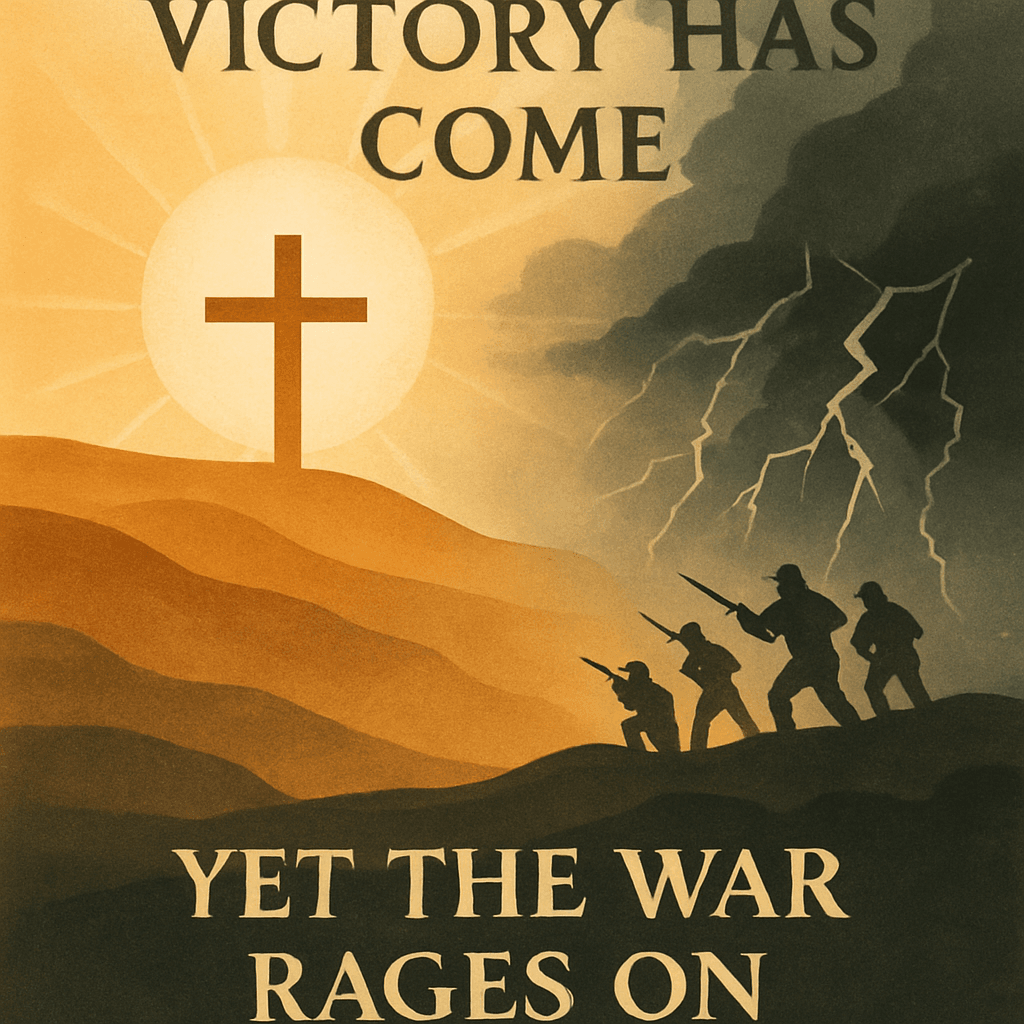
Victory has come yet the war rages on
“It is finished.”
It seemed that darkness had won, that the wicked had prevailed, and it looked as if all hope was lost. It was at that moment when these 3 words were uttered by Our Lord and Savior Jesus Christ; all of creation shook, evil rejoiced, and darkness fell upon the Earth. Little did they know that with these 3 words, our Lord was claiming Victory.
In the days following those moments Jesus conquered the grave and secured the keys to death and Hell. Our Savior resurrected from the dead and walked the Earth again. He then ascended to Heaven to sit victoriously at the right hand of the Father, for his mission was complete. He had given himself as a sacrifice for us because we owed a debt that we couldn't pay and we were in a fight that we couldn't win.
This fight began before the foundations of the Earth had settled. This fight isn’t even just a fight. It is an all out war, and even though Our Lord Jesus Christ claimed ultimate victory, the war still rages on today.
It was long before John’s Revelation, and the letters from Paul. It was before the empty tomb and the Roman Cross. Before David’s reign, and Joshua’s march, or Moses Exodus and Noah’s Ark. It was before we fell into sin and death. The war of good and evil was started before Adam’s first breath.
A prideful rebellion in the heart of Heaven has now become a war that is fought in the minds and hearts of all men. Sadly, the truth is, whether we want to recognize it or not, our fallen world is being consumed by this fiery conflict. There is also the unfortunate reality that most of socitety is so engrossed in the sinful nature of this world, that they don't even know there’s even a war to begin with. It’s truly the blind leading the blind while bullets breeze past our heads.
When I finally came to the lord there was a rush of emotions and with that also came an intense revelation about what has truly been going on all around us since the beginning of time. It’s as if I was a civilian in a place under enemy occupation and getting saved was like I had picked up a weapon and the occupying forces turned their guns toward me.
I felt like me declaring Jesus as Lord had placed me firmly in the sights of enemy fire. I was overwhelmed with attacks, persecution, and a constant battle to free myself from the darkness that once plagued my soul. It took what felt like forever to finally come to the realization that this war that I felt inside and all around myself has already been won. Not only had the war for my soul already been won but the very spirit of the king who won this battle lives within me.
I soon learned that as a child of God and a born again believer we must come to realize that even though darkness rages all around us, the blood of Jesus Christ has claimed ultimate victory. Even though I am called to fight the good fight while being strong and courageous, I can rest assured in the fact that evil has no claim or authority over me or my life. In the words of King David in the 23rd Psalm “Yea, though I walk through the valley of the shadow of death, I will fear no evil; For you are with me”.
It’s not always going to be easy, we must continually put on the full armor of God, and fight for those who are still lost. We fight for the weak, we fight for the blind, and we fight to remind our brothers and sisters that even though evil surrounds us, the tomb is still empty.
The enemy tries to condemn us but the tomb is still empty. The world spews hateful lies, but the tomb is still empty. The Devil tells you that you're unworthy but the tomb is still empty. He whispers “Look around, it’s over, there's nothing you can do to save yourself”.
But that's just a lie to distract you from the fact that THE TOMB IS STILL EMPTY.
So lay hold on the Victory that is found in our Lord Jesus Chirst and find joy in suffering for the Gospel. Pick up your cross and follow the one who has already won this fight. Cherish the fact that you’re on the team that has won and do whatever you can to make the celebration in Heaven as packed with people as possible. It is our duty to bring people to the truth. It’s our duty to share the glorious gifts of love, mercy, and grace that have been given to us and it’s our duty to help people find their way to the only one that can win the war for their soul. Start your days knowing that the fight is won and be greatful that you have the opportunity to bring others into this Victory.
At this very moment the war continues to rage and the Lord is asking
“Who will go for us”
It is in this moment that we should answer confidently and say “Here am I, Send Me”
But If Not...

But if Not…
Most people know the story from Daniel, chapter 3 about King Nebuchadnezzar and the three Hebrew boys; Shadrach, Meshach, and Abednego. King Nebuchadnezzar made a decree that at the sound of the music, everyone must bow down to a giant golden image. Anyone who didn’t obey, would be thrown into a fiery furnace. The Hebrew boys worshiped the one true God, Yahweh, and did not bow to the image when everyone else did. Some Chaldeans told the King, and he was FURIOUS, and said he would give the boys one more chance, but if they didn’t obey, they would be thrown into the furnace that very hour and, “...who is that God that shall deliver you out of my hands?” (Daniel 3:15, KJV) The boys told the king they still would not bow down and, “If it be so, our God whom we serve is able to deliver us from the burning fiery furnace, and he will deliver us out of thine hand, O king. But if not, be it known unto thee, O king, that we will not serve thy gods, nor worship the golden image which thou hast set up.” (Daniel 3:17-18, KJV, emphasis mine).
This story has a happy ending. They were thrown into the fire (heated 7 times hotter than it was before), and God delivered them without so much as a smell of smoke on their clothing. The king was amazed and promoted Shadrach, Meshach and Abednego and passed a new decree that anyone who spoke against the God of Shadrach, Meshach, and Abednego would be “...cut in pieces, and their houses shall be made a dunghill: because there is no other God that can deliver after this sort.” (Daniel 3:29, KJV)
Shadrach, Meshach, and Abednego knew there was no humanly way to get out of this situation, but they had complete trust in the God they served. They knew He was able to deliver them. They believed He would deliver them… But what if God had chosen NOT to deliver them from the fire? “...our God…will deliver us out of thine hand, O king. BUT IF NOT…” (emphasis mine)
But if not… There is so much packed into those three little words. What happens when we pray, fully believing that God will answer our prayer, but he doesn’t answer in the way we hope or in the way that we feel would surely be in His will? Do we still believe that He is God and He is good and His will is perfect, even when we don’t understand it?
We pray for healing and God chooses not to heal. We pray for the salvation of our loved ones and they never choose to trust in Christ. We pray for God to provide us with a spouse or a child and we remain single or barren. We pray for deliverance from an addiction, but we continue to struggle with it daily. We pray for a child who is out of the will of God, but the child continues upon the path he has chosen. These are all prayers that in our human minds appear to be in the will of God. God clearly says He will answer our prayers when we pray in His will. “This is the confidence we have before him: If we ask anything according to his will, he hears us. And if we know that he hears whatever we ask, we know that we have what we have asked of him.” (1 John 5:14-15, CSB)
Here is the reality of our human mind. We don’t know the mind of God and often don’t know His ultimate will. “For my thoughts are not your thoughts, neither are your ways my ways, saith the Lord. For as the heavens are higher than the earth, so are my ways higher than your ways, and my thoughts than your thoughts.” (Isaiah 55:8-9, KJV) God knows the end of the story. We do not. Those three words, “but if not” require us to have faith that whatever God chooses, whatever God allows, however God answers… He is God and we are not. It will be for His glory and our good.
I remember being in the hospital for 2 months. I was praying to God for understanding, and he gave me only one verse. “And we know that all things work together for good to them that love God, to them who are the called according to his purpose.” (Romans 8:28, KJV) I told God that I could not see how good could come out of what had happened to me and begged Him for another verse. When he didn’t give one to me, I asked him to show me, and He did. He showed me one good thing after another that had come out of my situation. But the reality is, even if He had not shown me, and even if I never understand why I went through what I did, God is still God and God is still good and I can trust Him with all I have.
Through that situation and many others, God has taught me that sometimes we see a mountain in front of us. We can’t see what is on the other side of the mountain; all we see is the impossibility of it. But God sees and knows it all. He knows the beauty on the other side, he knows the difficulties we will face as we climb it and He promises to be with us and give us strength to endure. “God is our refuge and strength, an ever-present help in trouble.” (Psalm 46:1, KJV) “Fear not, for I am with you; be not dismayed, for I am your God; I will strengthen you, I will help you; I will uphold you with my righteous right hand.” (Isaiah 41:10, KJV).
What are you praying and trusting God for? He promises that he will answer our prayers. He just may not answer them in the way that we think they should be answered. So pray in faith, believing He will answer in the way you ask. But if not, know that God is still God. He is still faithful. He is still good and His answer is the answer that is exactly what you need and will bring the most glory to Him.
Finding Christ in Every Season

Finding Christ in Every Season
The Four Seasons of Christ
There’s something sacred about the rhythm of the seasons. They come and go with beauty, challenge, and purpose, each one telling a story about life, death, and renewal. As I’ve grown in my walk with Christ, I’ve come to see that these changes in nature mirror the spiritual seasons we all experience.
Just as the earth cycles through summer, autumn, winter, and spring, so do our hearts. And in each of these seasons, if we look closely enough, we can find the story of Christ written in creation itself.
When I first got saved, everything around me felt new. It was as if the world had been repainted, brighter, clearer, alive with purpose. I started looking for Christ in everything I could throughout the day-to-day.
I watched the birds fly as if they were being lifted by the same grace I had felt. I watched water flow so clearly and in one direction, just as my spirit began to flow in His will. I even found meaning in the quiet moments alone. The more I searched, the more I saw His fingerprints everywhere, especially in the seasons.
Summer – A Season of Growth and Development
Summer is the season of warmth and light. The days are long and hot. Under the sun’s rays, everything either grows or withers.
In my walk with Christ, I’ve realized that walking in the light of The Son feels much like being in a refiner’s fire. It isn’t easy, and it isn’t quick. It takes a surrendered heart, one willing to trust the process of sanctification.
Just as summer is the season to till the land, plant seeds, and water them faithfully, it is also a season of spiritual preparation. We must till the soil of our hearts, breaking up the hardened ground, removing the stones that hinder growth, and allowing the Word to take deep root. Then, as the heat of trials comes, we must water our faith through prayer, Scripture, and obedience, so we do not shrivel under pressure.
This is the season of growth and testing. It’s where character is formed and faith is refined. It’s the season of ministry, work of endurance.
In the life of Jesus, summer represents His ministry on earth the years of healing, teaching, planting, and preparing hearts for the harvest to come.
Autumn – Change, Reflection, and the Harvest
Autumn, or Fall is a season I’ve always loved. It’s the season of change. Leaves turn from green to radiant colors of red, yellow, orange, brown before falling gently from the branches that once held them vibrant and alive.
Nature begins to slow down, and so do I. In this season, I often feel God touching my heart, urging me to let go of the things that no longer belong. To release bitterness, fear, and old habits. To see less of myself and more of others.
Autumn carries soft sadness, a quiet peace. There’s beauty in the dying leaves, a reminder that letting go can be holy. I often sit and reflect during this time, feeling both melancholy and grateful. Grateful for the growth that has happened. Grateful for how God brings change, even when it’s hard.
This is the season of thanksgiving, when the harvest is brought in. The seeds planted in the summer now bear fruit. People gather, thankful for what has grown, yet sometimes forgetting Who it is we thank and why.
In the story of Christ, autumn mirrors His persecution and crucifixion the slowing down, the surrender, the pain before the promise. It’s the season when He was whipped, bloodied, and bruised on the cross. Yet even in His dying, there was purpose. It was a great harvest of souls.
Winter – Cold, Stillness, and Purity
Winter has always been a season I’ve struggled to appreciate. It feels so cold and lifeless, everything is dead or dormant. The days are short, and the nights seem endless. Scientifically, the sun is at its furthest point from the earth, and spiritually, it can feel that way too.
This is the season of faith. Faith that the sun will rise again. Faith that warmth will return, even when everything looks barren. When you look at the fields and trees, it seems like nothing is alive. But stillness doesn’t mean absence.
There’s beauty hidden in the silence. The trees may be bare, yet ice and frost glisten on their branches, catching the smallest rays of light. The snow covers the ground, white and pure soft to the touch yet echoing loudly under each step.
Winter reminds me that when God is silent, He is not absent. He is preparing for something greater.
This season reflects the time between crucifixion and resurrection of the stillness of the tomb. The Son felt distant, just as the winter sun felt far from the earth. Yet even then, God was working. In the cold, dark silence, the greatest miracle in history was being prepared.
Winter is the death of Christ the time when He was wrapped in burial clothes, laid in a cold, damp tomb. It was silent, but not hopeless. The silence of winter is never the end—it’s the quiet before rebirth.
Spring – New Life and Resurrection
Then comes spring, the season of renewal, life, and resurrection.
After the stillness of winter, everything begins to stir. Trees start to bud, flowers bloom, and the air fills with the hum of bees and the songs of birds. The warmth returns, and the world feels alive again.
Spring is a celebration of new beginnings. It’s the joy of color returning after months of gray. It’s nature praising its Creator in harmony everything declaring, “He lives!”
Just as winter could not hold back spring, the tomb could not hold back Jesus. He defeated death. He conquered the grave.
When I accepted Christ, I experienced my own springtime. The old me was buried in the winter of my life, and a new man rose in the warmth of His light. A spring of living water began to flow in me, cleansing and renewing me.
This season mirrors the resurrection of Christ the moment when life triumphed over death, and hope burst forth from the darkness.
Conclusion – Christ in Every Season
In every season, I have found the story of Christ. From the warmth of growth to the cold of silence, from the letting go of autumn to the resurrection of spring He is present in them all.
God foreshadows Christ throughout the Bible, and it only makes sense that He would do the same in His creation. The seasons testify to His story, His love, and His unchanging nature.
The world continues to turn, and the seasons keep changing. But Christ remains the same faithful, constant, and eternal.
“Jesus Christ the same yesterday, and to day, and for ever.” — Hebrews 13:8 (KJV)
When we seek Him, He is always faithful to reveal Himself. And just as the earth cycles through its seasons, so too do we. Whether we’re in the heat of refining, the chill of waiting, or the joy of renewal Christ is there, unchanging in every season of our lives.
The same God who paints the leaves in autumn and melts the snow in spring is shaping your heart with that same careful hand. Seasons will come and go, but His love and purpose remain constant.
In All Things

"Rejoice evermore. Pray without ceasing. In every thing give thanks: for this is the will of God in Christ Jesus concerning you." - 1 Thessalonians 5:16-18
So often we find ourselves asking, ‘what is the will of God for my life?’. I can’t tell you how many times I’ve heard it said by friends and family, ‘I want to find the will of God for my life.’. It is interesting to me how God has instilled this very same desire deep within each of us to abide in His will. But what exactly is the will of God for our lives? Could it be that each of us has a calling for the same will over our lives? And if so, what is that perfect will of God?
Several years ago, I heard a sermon preached on this very same passage of scripture and it changed the way I thought of and pursued the will of God for my life. I was always in search of something that would apply only to me, or that would be specific to my gifts, but I was thinking about and approaching it all wrong. I realized that the will of God for our lives is rather simple and involves our daily comings and goings to revolve around Christ. Every thought, every word spoken, every action should all be to the glory of God.
1 Thessalonians 5:16-18 tells us point blank what the will of God is for our lives. To rejoice evermore. To pray without ceasing. (And) give thanks in everything. Now that we have the recipe to enact the will of God in our lives, what does that look like in application format?
First, we are called to ‘rejoice evermore’. To rejoice, or have an attitude of rejoicing, simply means to have a deep sense of delight and gladness not based on one’s own circumstances but on the Lord. It is the action of finding joy in God’s character and the hope of our salvation, even amid our struggles, our suffering and sorrows. The command of rejoicing in all things gives us strength and encouragement to praise and feel the overwhelming sense of joy that only the Lord can bring, both in our most wonderful seasons and in our most difficult situations. This joy can remain even in our downfalls because of the unwavering foundational love and relationship we have with Christ. Jesus is our source of strength, our comfort, and our peace. No matter what life brings our way, we are called and commanded to rejoice in all things because our joy is not rooted in our circumstances but in God.
Second, we are called to ‘pray without ceasing’. Our thoughts should be a continual string of prayer. We should remain in constant communion with the Lord both in our hearts and our minds. This is the form of having an attitude of prayer. We are called to integrate prayer into all aspects of our life. It is a wonderful thing to practice the habit of setting aside specific times for prayer; however, it is even more wonderful to stay in constant prayer with the Lord. We are called to pray through all of life’s happenings. There are many different types of prayers, as mentioned in 1 Timothy 2:1, ‘I exhort therefore, that, first of all, supplications, prayers, intercessions, and giving of thanks, be made for all men.’. We are called to be in continual prayer with the Lord: bringing our specific needs, our general requests, our confessions, our prayers on behalf of others, and our prayers of praise to God. The act of being in constant prayer with the Lord will not only strengthen our faith but it will enable our minds to focus on Christ and not on our current circumstances. As the Bible promises, those who stay in continual prayer will be kept in the perfect peace of Christ: Isaiah 26:3, ‘Thou wilt keep him in perfect peace, whose mind is stayed on thee: because he trusteth in thee.’.
Last, we are called to ‘give thanks in every thing’. Life will be filled with ups and downs. We know there are seasons of flourishing and thriving. And then there are seasons where we struggle and feel weak. A season may only last for a few days or weeks, but sometimes it seems they last for months on end. We can experience sadness, disappointment, loneliness or longing, fear and anger, time and time again. We can receive bad news from a family member or a friend, or a bad report from a doctor, and it feels as if our entire world has turned upside down. In these moments we must remember that we are called to act and respond in the will of God. We are commanded to give thanks in every season, in every situation, in every moment. The act of giving thanks in all things keeps our hearts and minds focused on God’s goodness and sovereignty. Giving thanks is a component of prayer, therefore, the previous command to ‘pray without ceasing’ is twofold, as you cannot pray continually without also giving thanks to God. As stated in James 4:8, we are to ‘Draw near to God, and he will draw nigh to you.’. What a beautiful truth it is to know that when we bring ourselves to the Lord in all things, that He will draw closer to us. The giving of thanks is an act of worship and praise and can assist in strengthening our faith and trust in the Lord.
God wants to have an intimate relationship with us. He has invited us to act in His will for our lives. To rejoice in all things, to be constant in prayer, and to give thanks for everything. Acting in His will for our lives will draw us closer to Him. It will strengthen our faith, comfort us in our hardships, and give us peace in painful times. We certainly cannot control the circumstances and struggles that life will throw at us, but we can decide and choose how we will respond to them. In this passage of scripture (1 Thessalonians 5:16-16), we are invited to respond to the ups and downs of life in a different way from our natural response. We are invited to respond in rejoicing, praying, and with thanksgiving. Life may feel uncertain at times, but we must cling to the rock, the firm foundation, that is Christ. He is the very anchor of our soul (Hebrews 6:19). Let us choose to act according to His will for our lives and encourage one another to do the same.
-Written by Libby Jenkins
The Right Response to a Knocking Door

They knocked on my door on a Saturday morning. My husband was gone to play tennis, both kids were playing video games downstairs with the sound on full blast and my house was a wreck. At nearly eleven AM I’m still hanging out in my bathrobe and pajamas, unwashed hair tossed up in a claw clip.
I couldn’t see them clearly through the translucent cling film on my front door. We didn’t need a new roof, my husband is our bug guy, and FOR THE LAST TIME, I’m not switching to AT&T. But there were three people, two men and a teenage girl. So what flavor of pseudo-Christianity would they be peddling?
No white button downs. Don’t Mormons wear button downs? Or is it Jehovah’s Witnesses?
I opened the door and stood on the threshold letting all the mosquitos in. They identified themselves as Jehovah’s Witnesses. Vulnerable as I was in my pajamas outnumbered by strangers with my husband not home, they seemed more nervous than me. Across the great divide from the bottom of my front porch stairs the first man held out a pamphlet.
Would I read it? he asked. Yes, I answered.
Both sides hesitated then. I stood there wondering when they were going to ask to come inside. Isn’t that what normally happens? Instead they thanked me and left. Something felt unsaid. From an upstairs window I discreetly watched them canvas the entire culdesac, wondering which of my neighbors answered the door, which of them took the pamphlet like I did.
Some could say good riddance. Go away and never come back. God’s position on false teachers is clear in the Bible:
“For certain men, who were designated for this judgment long ago, have come in by stealth; they are ungodly, turning the grace of our God into promiscuity and denying our only Master and Lord, Jesus Christ” - Jude 1:4
“Dear friends, do not believe every spirit, but test the spirits to determine if they are from God, because many false prophets have gone out into the world” - 1 John 4:1
“For such people are false apostles, deceitful workers, disguising themselves as apostles of Christ. And no wonder! For Satan himself is disguised as an angel of light” - 2 Corinthians 11:13-14
There’s an interesting story about Charles Taze Russell, the man who founded the Jehovah’s Witnesses. To sum it up, Russell claimed that he knew Greek and therefore needed to retranslate the Bible to suit his false teachings. His writings were criticized by another man,
Reverend J.J. Ross, so Russell sued him for libel. During the hearing Russell was unable to even recognize one letter of the Greek alphabet. If he lied about this, what else did he lie about? He certainly didn’t have the credentials to translate any document whatsoever. I think we could safely make the conclusion that he falls into the category of false teacher for this alone and not even considering the many failed prophecies he proclaimed.
I don’t want my neighbors to read the Jehovah’s Witnesses’ tracts. I don’t want them to internalize these false ideas about God that false teachers created. The idea that people that I care about could be led astray is upsetting.
But those three people who stood on my doorstep have been led astray. I don’t know their story but I want them to come back so they can share it with me. I regret allowing my internal struggles about appearance or insecurities to distract me from digging deeper with these people whom God loves. We could hate them–them or anyone else who comes to proselytize for any religion we don’t agree with–or we could choose to look at them as God does.
My greatest hope is in Jesus, that when I close my eyes for the final time I will open them in his presence. My salvation was freely given after Jesus paid for it in blood.
“Therefore, there is now no condemnation for those who are in Christ Jesus, because through Christ Jesus the law of the Spirit of life set me free from the law of sin and death” - Romans 8:1
I am free from the power of sin in my life. Fear and anxiety, my greatest tormentors, have been conquered by Jesus.
“No, in all these things we are more than conquerors, through him who loved us” - Romans 8:37
Jehovah’s Witnesses believe in a works-based salvation. Only 144,000 people since the time of Jesus will be ‘sealed’ and the rest can only hope to survive a coming apocalypse. Now in the present time, the Witnesses believe that the door to ultimate salvation is shut.
To put it simply, Jehovah’s Witnesses are knocking on doors to earn their salvation. The three from my experience knocked on my door to hand me a pamphlet, one of many that they are obligated to pass out. Whether or not they cared about me specifically I’ll never know, but passing out literature is another task on the Jehovah’s Witness salvation checklist.
Tragically, my door and every other door they knock on to earn their salvation is the wrong one. We know that salvation comes by grace through belief in Jesus Christ.
“That if you confess with your mouth, ‘Jesus is Lord,’ and believe in your heart that God raised him from the dead, you will be saved” - Romans 10:8-9
One of my favorite verses comes to mind. I feel that it’s fitting here. Jesus said:
“I am the door. If anyone enters by Me, he will be saved” - John 10:9
Please join me in praying for these three individuals and all the others who have been led astray, that they would hear the Lord’s call and knock on his door. Let us pray they will find the freedom of God’s grace.
I encourage you to learn from my mistakes and engage them kindly and without restraint. With God’s help, let us be ready at any moment to share the truth of the Gospel. I also pray that we would have the same zeal to witness to our neighbors but instead of witnessing out of obligation, we would instead witness out of love.
Maybe those three will knock on my door again. I hope so. This time I’ll invite them in, ready or not, and tell them about the true Door.
The Son of Suffering
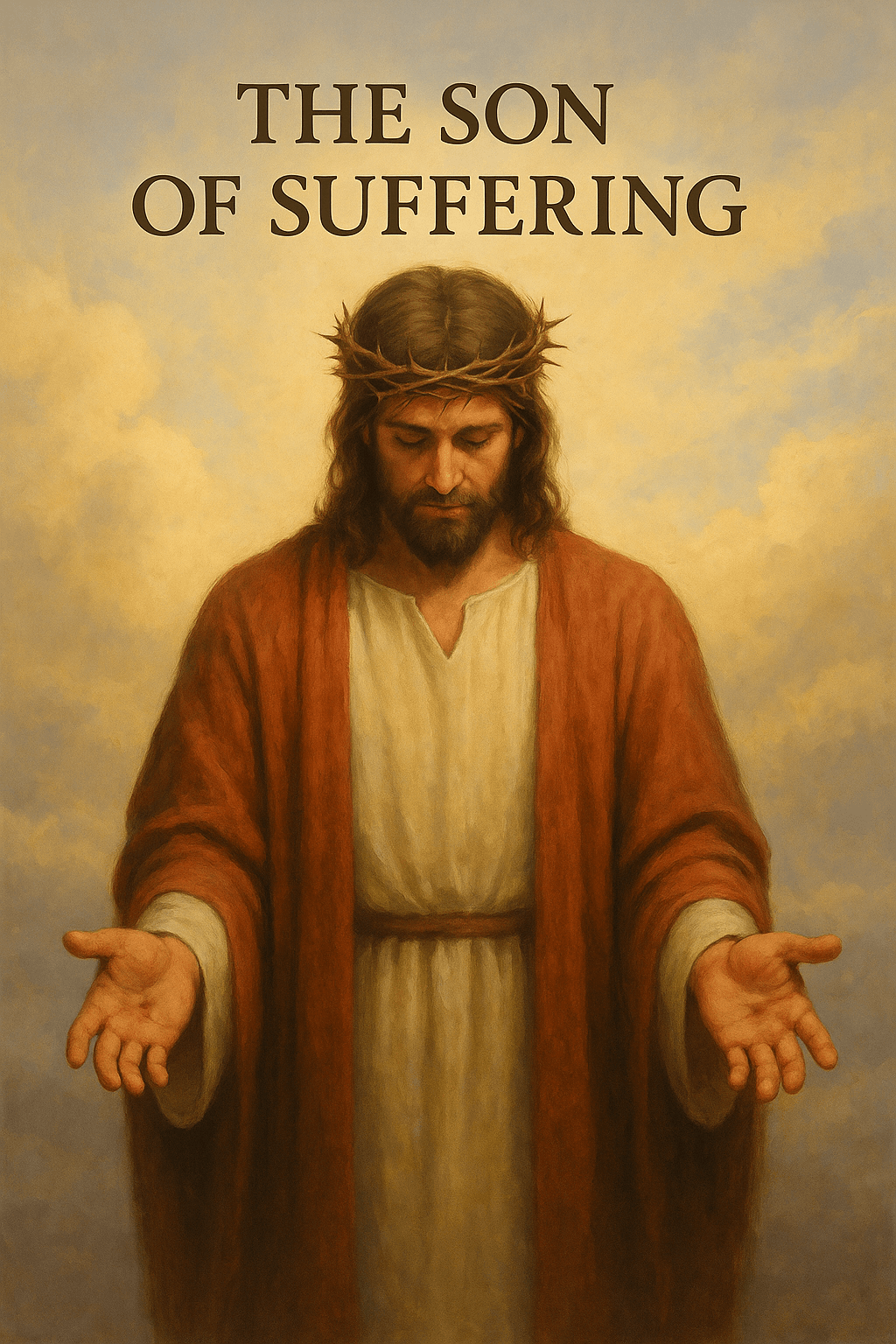
The Son of Suffering
Have you ever been going through something difficult and, even though your circumstances didn’t improve, there was comfort in talking to someone who had been through something similar?
Perhaps you meet another couple who has lost a child. Or you cross paths with someone struggling to care for aging parents. Maybe it’s a widow struggling with life after loss.
No matter the scenario, simply talking to someone who can relate acts as a balm to your hurting heart.
When I was going through some of the darkest days of my life (doubting my salvation, depression, etc.), I felt so alone. No one seemed to comprehend my struggle. With good intentions, they tried to offer help. But they didn’t understand the pit I was in.
When God opened my eyes to the root cause of my problem - OCD - which, perhaps will be a future blog post, I remember wanting to hear from others who had struggled with the same thing. The compulsive prayers, the endless doubts, the lack of assurance no matter how many Romans Road scriptures I knew. Hearing others’ testimonies brought hope and made me see I wasn’t alone.
Yet the other morning on my way to work, the Holy Spirit spoke to me through some song lyrics, which I had actually heard multiple times before. But that morning, it was different.
How can it be?
There’s a God who weeps
There’s a God who bleeds
Oh praise the One
Who would reach for me
Hallelujah to the Son of Suffering
Yes. God made us to be around others. He even uses other people who have been through similar trials to comfort us as they have received comfort. (2 Corinthians 1:3-4)
But even when there is no human comfort, praise God, He is there. He understands.
The Son of Suffering sees you, tired mom, praying over a wayward child.
The Son of Suffering knows the ache of an empty womb, weary couple.
The Son of Suffering comprehends the burden of caring for a loved one with an illness.
The Son of Suffering understands the sting of a life filled with unmet expectations.
Hebrews 4:15 tells us, ‘For we have not an high priest which cannot be touched with the feeling of our infirmities; but was in all points tempted like as we are, yet without sin.’
Jesus is touched by the feelings of our infirmities. Because of that, it goes on to say in verse 16, ‘we may obtain mercy, and find grace to help in time of need.’
The pain may not go away. However, there is One - Jesus - who sees you in it. And not only does He see You, but He longs to comfort you.
What grace. The Son of Suffering, suffering with us.
But there’s more.
The Son of Suffering suffered for us.
Isaiah 53:5 says, ‘But he was wounded for our transgressions, he was bruised for our iniquities: the chastisement of our peace was upon him; and with his stripes we are healed.’
Jesus took on the penalty that was meant for you and I. And because of His suffering, we can have eternal life when we repent of our sin and place our faith in Him.
Romans 10:9,13, ‘That if thou shalt confess with thy mouth the Lord Jesus, and shalt believe in thine heart that God hath raised him from the dead, thou shalt be saved. For whosoever shall call upon the name of the Lord shall be saved.’
The lyrics continue…
Your cross, my freedom
Your stripes, my healing
All praise King Jesus
Glory to God in Heaven
We’re not promised a life free from all suffering. But we can find comfort in knowing that, when we do suffer, we are not alone. And, that the ultimate suffering of an eternity in Hell doesn’t have to be our fate.
Oh, praise the One
Who would reach for me
Hallelujah to the Son of suffering!
Awake into Life Eternal

Wherefore, as by one man sin entered into the world, and death by sin; and so death passed upon all men, for that all have sinned: - Romans 5:12
Imagine a globe sitting on a desk. You walk up to the table, grab the globe, and spin it on its axis. After a few seconds you reach out with your index finger and stop the spinning globe. Wherever your finger lands, if it is a place inhabited by people, then at some point in time a grievance, injustice, or atrocity has occurred there. Although we live in 2025 amid the most advanced civilizations to ever exist on earth there has yet to be any technology, science, psychology, or philosophy to correct the most fundamental human problem, the sinful heart of man. After Adam and Eve chose to rebel against God, the hearts of mankind had become tainted, and like a dark thread interwoven throughout time the curse has connected all of us to that singular action in the Garden. Cain and Abel, the first brothers to be born on earth immediately fell victim to what would inevitably be within us all. Cain’s pride and jealousy gave birth to hate which manifested itself in the murder of Abel. Cain had the opportunity to love his brother, he killed him instead. Humanity’s attempts at rectifying evil, to overcome the sins that plague us all have lead only to more death and suffering in the name of achieving equity and earthly Utopia. Ever since the fall of humanity in the Garden, there has been a yearning from the thinkers, the great philosophers to try and understand our purpose, make sense of our existence, and rationalize suffering. There is a void at the center of every heart and it longs to be filled. However, the issue is that it cannot be filled with anything material. The void within us is spiritual. When humans and or governments try to implement the teachings of Nietzsche, Marx, or even Socrates the effort is always doomed to fail if the goal is perfection, for our sinful nature has and will always remain imperfect therefore corrupting any man made system or social structure.This is to say no matter how good the system, every individual person is tethered to the basic truth that “all have sinned”, which always leads us back to destruction as it did Cain. Adam and Eve walked with God Almighty; He loved them and communed with them, He was their reason for existence. When they were banned from the Garden of Eden the world became dark and dull, and what our hearts so desire is to be walking with God once again; this is what He had intended for us from the beginning. Nothing in our world can ever compare to speaking with God in the cool of the day, on a crisp morning, amidst the trees and walking among Creation in perfect harmony. Our reality turned to something lesser, a mere dream and fragment of that which was in the Garden when Creation lived united with the Creator. Every mortal soul now wanders about aimlessly, physically alive at present but spirituality asleep. Will there ever be something to awaken us from the self inflicted nightmare we find ourselves in?
For if by one man’s offence death reigned by one; much more they which receive abundance of grace and of the gift of righteousness shall reign in life by one, Jesus Christ. - Romans 5:17
At the Greater Heights Family Huddle this year Pastor Chris expounded upon the books written by the apostle John. Throughout his gospel and his letters John shares with us two extraordinary truths that are powerful beyond comprehension but also personal and comforting for any individual. Jesus, the man born in Bethlehem and whose ministry and message has spread across time and generations was not merely a prophet or philosopher; Jesus was there at the beginning of time itself, but not as an observer. He was there one with God because He is God the Creator, the one who walked with Adam and Even in the cool of the day. “All things were made by him; and without him was not anything made that was made.” “That which was from the beginning, which we have heard, which we have seen with our eyes, which we have looked upon, and our hands have handled, of the Word of life;”.”I am Alpha and Omega, the beginning and the ending, saith the Lord, which is, and which is to come, the Almighty.” Jesus of Nazareth is the King of Kings and the Lord of Lords, He is the Lion and the Lamb, He is perfect love and He is perfect justice. Simply put, John reveals to us that Jesus was and is God, He is life and light. The earth after being introduced to sin had become dark; Jesus stepped down into our darkness to light the world and awaken humanity from the nightmare. John 1:4-5 says “ In him was life; and the life was the light of men. And the light shineth in darkness; and the darkness comprehended it not.” The second truth John reveals is equally as powerful as is personal. 1 John 1:3 says “That which we have seen and heard declare we unto you, that ye also may have fellowship with us: and truly our fellowship is with the Father, and with his Son Jesus Christ.” Jesus, the creator of the universe is inviting you into a personal relationship with Him! This is the reason for His manifestation on earth. He came to pay our penalty for sin with the purpose of our redemption, and to draw us back to Him, to draw us into life eternal. As Pastor stated during Family Huddle, this is what it means to be a Christian, everything that is done by the local and global church, every Christian ministry and program has begun in order to draw people into this miraculous personal relationship with Christ. C.S Lewis writes in Mere Christianity, “This is the whole of Christianity. There is nothing else... the church exists for nothing else but to draw men into Christ, to make them little Christs. If they are not doing that, all the cathedrals, clergy, missions, sermons, even the Bible itself, are simply a waste of time. God became Man for no other purpose.” The dark thread interwoven by sin that linked us to Adam has now been changed to scarlet and held together by the blood of Christ that reunites us with God the Father.
Wherefore he saith, Awake thou that sleepest, and arise from the dead, and Christ shall give thee light. - Ephesians 5:14
In Leo Tolstoy’s War and Peace one of the main characters named Prince Andrei has a dream after being mortally wounded. In his dream, he is healthy and sitting in a room, but a dark spirit (Death) is trying to enter and consume him. After a struggle Death breaks in and kills Prince Andrei. In the exact same moment Prince Andrei dies in the dream, he is woken up back into reality. He comes to the realization that “death is an awakening!” Jesus Christ stands at the door of every human heart knocking. The temporal life we experience is but a dream, the best it could ever be pales in comparison to the life eternal that Jesus offers that can begin today, even in this very moment. The life He offers is much greater than anything we can imagine, He offers us Himself. C.S Lewis says in Mere Christianity:
Christ says ‘Give me All. I don’t want so much of your time and so much of your
money and so much of your work: I want you. I have not come to torment your natural self, but to kill it...Hand over the whole natural self, all the desires which you think innocent as well as the ones you think wicked - the whole outfit. I will give you a new self instead. In fact, I will give you Myself: my own will shall become yours.’
When a person dies to the self and accepts Jesus is the Lord, He freely gives eternal life because this is the only life He offers, nothing less . The sinner can come to Christ today and accept the gift of eternal life that Jesus offers. For the saint, it is daily required to choose to live for the eternal life and not for the temporal as Pastor Chris preached this past Sunday morning. 1 Timothy 6:12 says “ Fight the good fight of faith, lay hold on eternal life, whereunto thou art also called and hast professed a good profession before many witnesses.” I would like to leave you the reader with a question. When you wake up every morning are you waking up into life, are you choosing to live after the eternal or the temporal? Very often Pastor Chris reminds us how we should start every morning. When the day begins we are faced with a decision. Will I live after my will, am I going to choose what I want, or do I kill it and choose Christ, choose the eternal? If we are to escape the dream, the rat race, the temporal life that is never satisfied we must surrender our will for Christ’s.
The great religious struggle is not fought on a spectacular battleground, but within the ordinary human heart, when every morning we awake and feel the pressures of the day crowding in on us, and we must decide what sort of immortals we wish to be. - Kathleen Norris
- Written by Jacob Littlefield